maintenance types, reactive maintenance, predictive maintenance, work order classification
Compare reactive, corrective, preventive, and predictive maintenance, and learn how to track maintenance type as a stable field in facilities work orders.

How facilities teams classify maintenance
Facilities teams use several maintenance approaches, typically described as reactive, corrective, preventive, and predictive or condition-based maintenance. These terms are often used inconsistently, which makes reporting unreliable and makes it difficult to plan staffing and budgets. A useful taxonomy defines each type, links it to how work is initiated, and keeps the classification stable throughout the work order lifecycle. In Layer, maintenance type is implemented as a stable field on work orders and is reinforced by views that separate planned work from unplanned work.
How the four maintenance types differ
Reactive maintenance is work performed in response to an observed issue, often initiated by an occupant request or a technician finding. Corrective maintenance is work performed to restore function after a failure, sometimes treated as a subset of reactive work but often used to indicate a repair rather than a minor adjustment. Preventive maintenance is planned work performed on a schedule. Predictive or condition-based maintenance is work initiated by monitored condition, such as inspections, sensor readings, or performance thresholds. The workflow includes defining the taxonomy, enforcing the field, and using it to drive day-to-day views and reporting.
Step 1: Define the taxonomy in practical terms
Write definitions that match your operations. For example, reactive maintenance can be defined as unplanned work initiated by a request or discovery. Corrective maintenance can be defined as unplanned work that restores function after failure. Preventive maintenance can be defined as planned work initiated by schedule. Predictive or condition-based maintenance can be defined as work initiated by a measured condition or inspection result.
The definitions should not depend on who did the work or how long it took. They should depend on why the work was initiated and whether it was planned.
Step 2: Implement maintenance type as a stable field
Add a Maintenance Type field to the Work Orders Category, with values Reactive, Corrective, Preventive, and Predictive or Condition-based. Classify the work at intake or triage, and do not change it later unless the classification was incorrect at intake. Keeping the field stable ensures reporting remains meaningful.
Add a Trigger source field if the team needs more detail, such as Occupant request, Technician found, Scheduled PM, and Inspection result. Trigger source can provide context without expanding the number of maintenance types.
Step 3: Use views that match operational needs
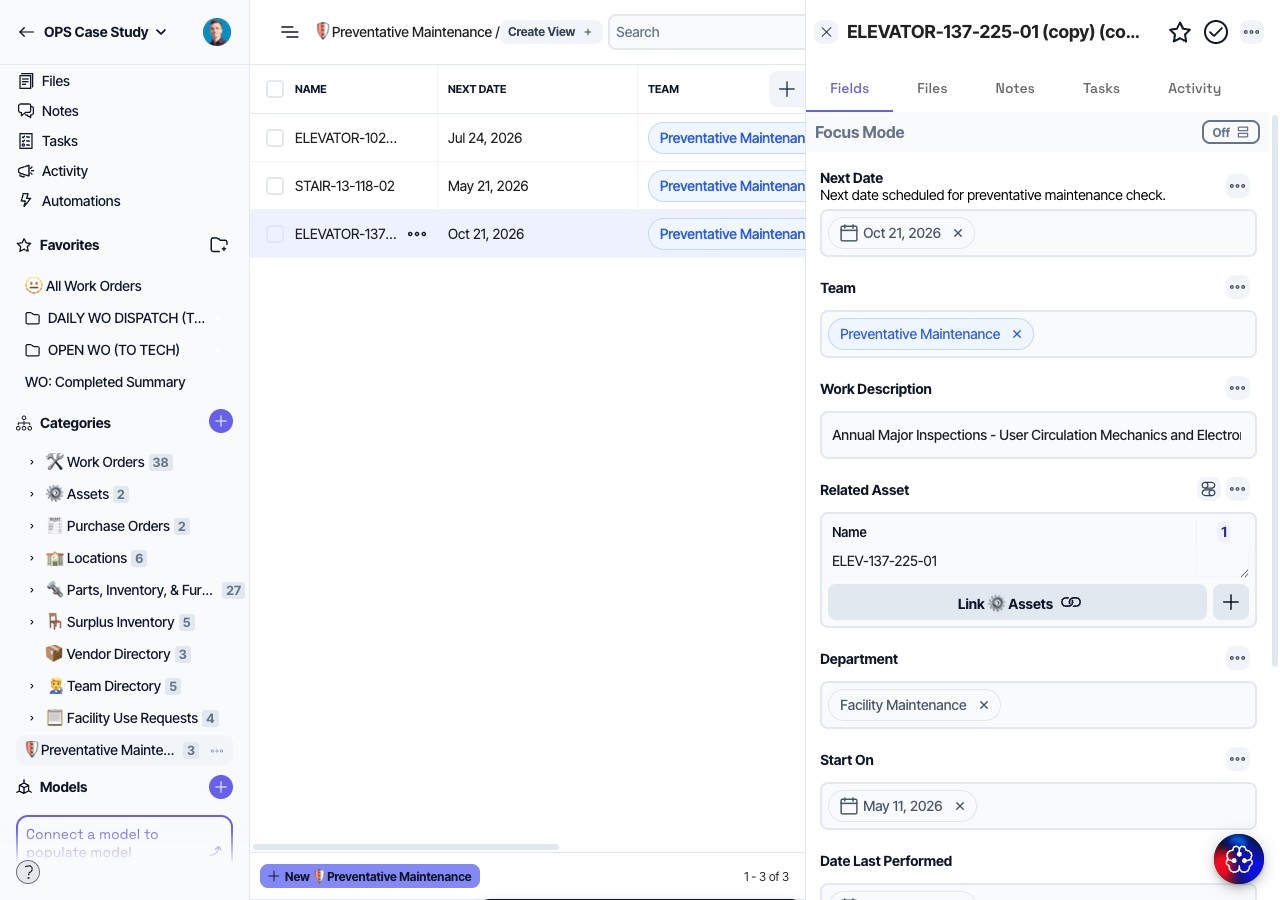
Create separate views for each maintenance type. Preventive work should have its own view for upcoming and overdue tasks. Reactive and corrective work should have views for unassigned work, in-progress work, and overdue work. Predictive work should have a view that highlights condition thresholds or inspection findings that require action.
When the views are in place, the taxonomy becomes operational rather than conceptual. Technicians can focus on the view that matches their assignment, and managers can balance planned and unplanned work.
Tips
Do not use status to represent maintenance type. Status should represent the stage of work, while maintenance type should represent why the work exists. Keeping these separate supports stable dashboards and prevents teams from reinterpreting status values.
When predictive maintenance is early-stage, treat it as condition-based work initiated by inspections, since inspections provide a consistent trigger even without sensors. As monitoring maturity increases, you can refine trigger sources without changing the top-level taxonomy.
Keeping the maintenance taxonomy stable over time
A maintenance taxonomy supports planning and reporting when it uses stable definitions and a stable field on work orders. In Layer, maintenance type is implemented as a picklist on work orders, supported by operational views that separate planned and unplanned work and make the classification meaningful in daily use.

