Submittals
A submittal is how a contractor shows that materials and products meet the contract documents before installation. Learn the types, the review process, and the standard status responses.

A submittal is a document or physical sample that a contractor provides to show how they intend to meet a specific requirement in the contract documents. Submittals are reviewed and approved before the related work is fabricated, ordered, or installed. They give the design team a chance to confirm that the products and methods a contractor plans to use match the design intent recorded in the drawings and specifications.
This article explains what submittals are, the common types, who is responsible for each step, how the review process works, and what the standard review responses mean.
What a submittal is for
The purpose of a submittal is verification. The construction drawings and specifications describe what the project requires, but they do not name every product or detail every fabrication method. A submittal closes that gap. It documents the specific product, material, or assembly the contractor proposes, so the design team can confirm it conforms to the requirements before money is spent on fabrication or installation.
Submittals also create a record. Once an item is reviewed and returned, the project has a documented decision showing what was approved and on what basis. That record matters if a question about conformance comes up later in construction or after substantial completion.
Common types of submittals
Specifications determine which items require a submittal. The most common types are:
Shop drawings. Detailed fabrication or installation drawings prepared by the contractor, subcontractor, or supplier. Steel connections, casework, and curtain wall are common examples.
Product data. Manufacturer cut sheets, catalog pages, and technical specifications for a proposed product.
Samples. Physical examples of a material, finish, or assembly, such as a brick, a carpet swatch, or a finished panel.
Mock-ups. Full-size assemblies built to confirm appearance, fit, or performance before the work proceeds at scale.
Manufacturer certifications. Documentation that a product meets a referenced standard or testing requirement.
Substitution requests. A formal proposal to use a product other than the one named in the specifications.

Who is responsible for each step
The contractor manages the submittal process. This includes collecting submittals from subcontractors and suppliers, reviewing them for accuracy and coordination, and transmitting them to the design team on the project schedule. The contractor is also responsible for the means and methods of construction, field measurements, and coordination between trades.
The design team reviews each submittal for general conformance with the design intent shown in the contract documents. The architect or engineer confirms that the proposed product or assembly aligns with the drawings and specifications. The reviewer does not take responsibility for dimensions, quantities, fabrication processes, or construction safety unless the contract specifically assigns those tasks. For a detailed explanation of the reviewer's scope, see What Is Submittal Review? A Guide for Architects.
How the submittal review process works
A typical submittal moves through the following steps:
The subcontractor or supplier prepares the submittal and provides it to the general contractor.
The general contractor reviews it, confirms coordination, and transmits it to the design team.
The design team logs the submittal and assigns it to the responsible reviewer, usually based on the specification section.
The reviewer evaluates the submittal for conformance with the contract documents and records a response.
The design team returns the submittal with a status and any comments.
If the response requires changes, the contractor revises the item and resubmits it as a new revision.
The approved submittal is filed as part of the project record.
The contract sets the review period, commonly 10, 14, or 21 calendar days. Returning submittals within that period matters because many items have long lead times, and a late review can delay fabrication or delivery.
Standard submittal review responses
Reviewers use a fixed set of responses so that the action taken on each submittal is clear. The exact labels vary by firm and contract, but the common responses are:
Response | Meaning |
|---|---|
Approved (No Exceptions Taken) | The submittal conforms. Work may proceed. |
Approved as Noted (Make Corrections Noted) | The submittal conforms with the noted corrections. Work may proceed if the corrections are incorporated. |
Revise and Resubmit | The submittal does not yet conform. The contractor must revise and resubmit before proceeding. |
Rejected (Not Approved) | The submittal does not conform and is not acceptable. |
For Record Only | The item is logged for the record and does not require approval. |
For a fuller explanation of each response and the single-letter codes used in many logs, see Submittal Review Status Codes Explained.
Tracking submittals on a project
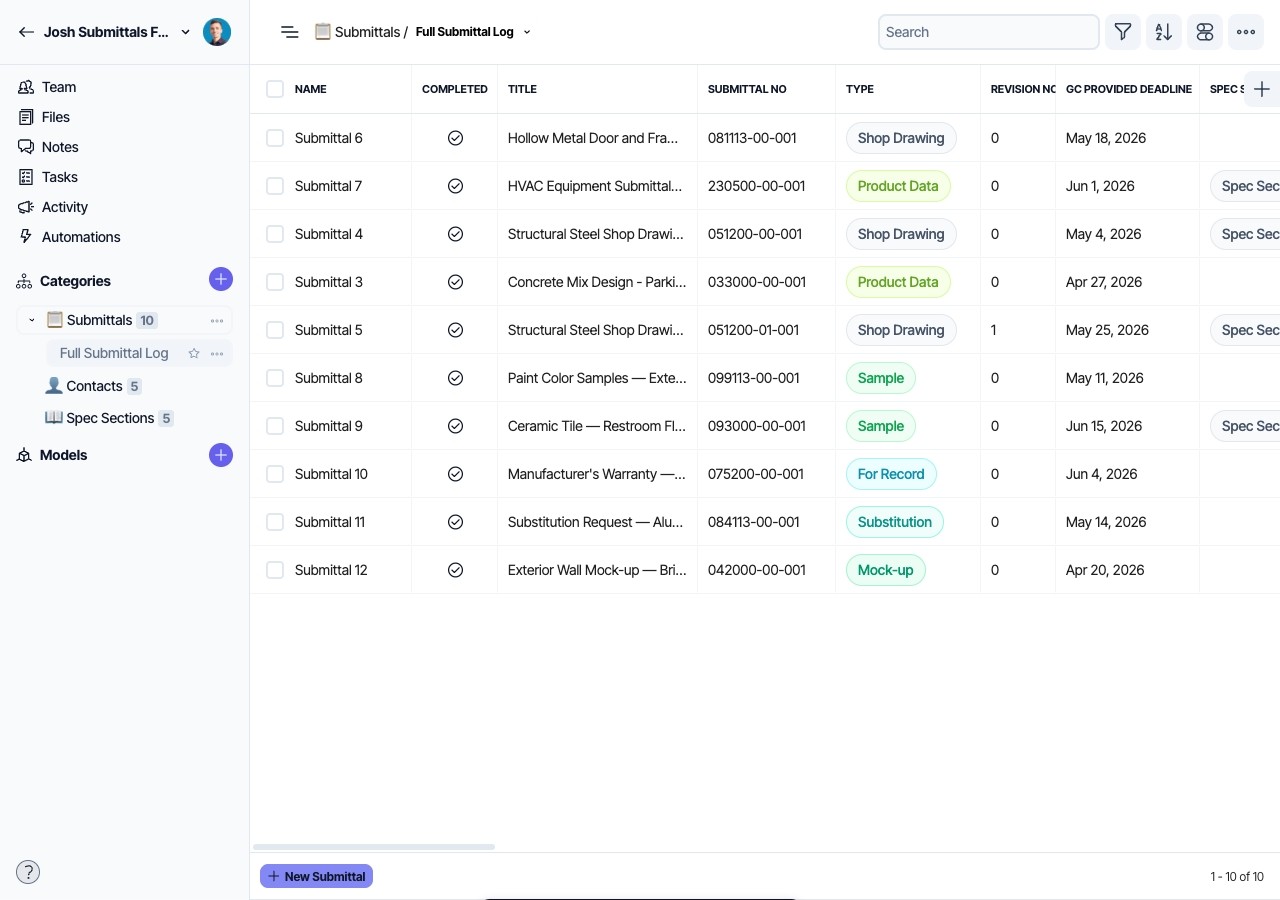
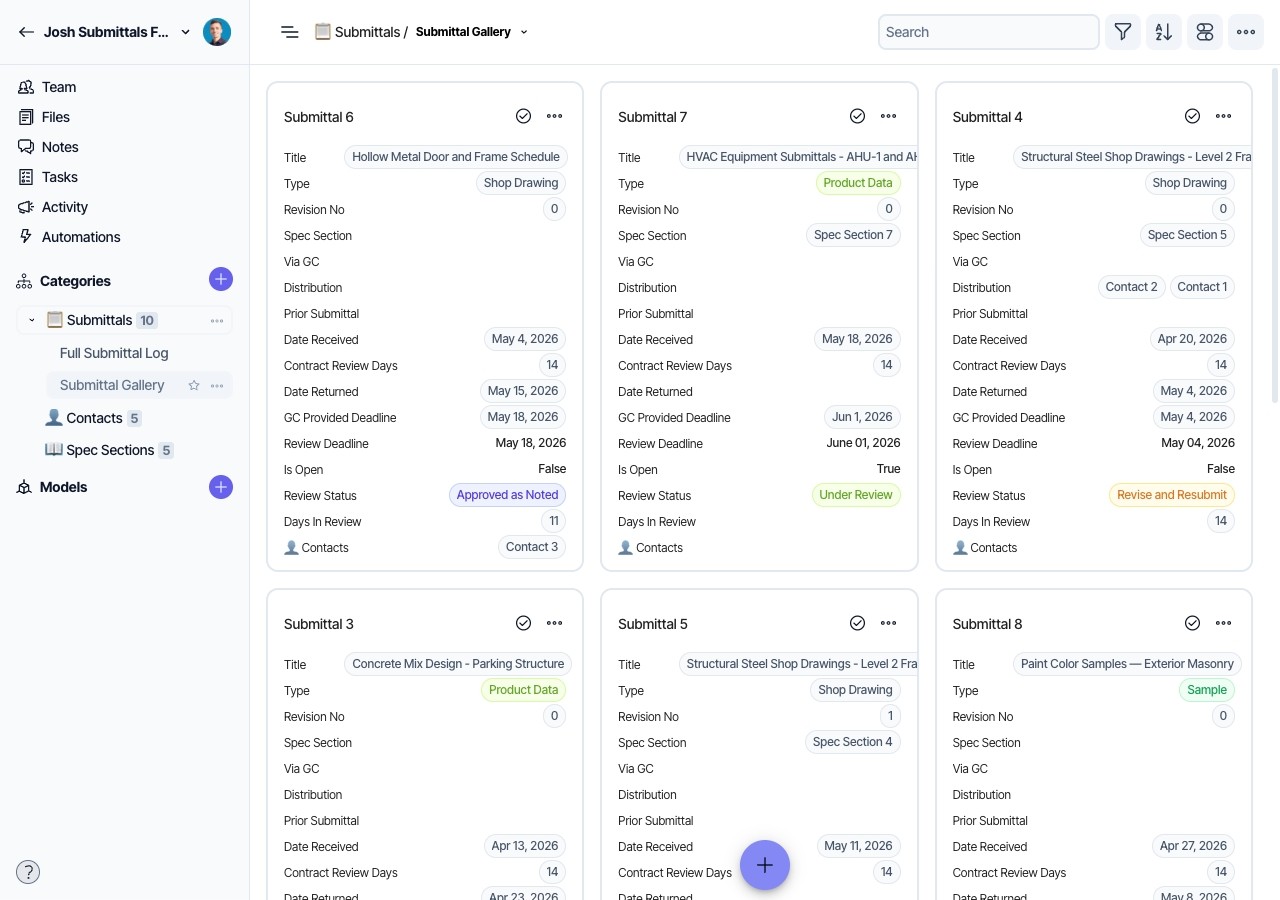
Most teams track submittals in a log that records the submittal number, specification section, type, reviewer, dates, and status. A spreadsheet handles the basics, but it requires manual maintenance to stay accurate as items move through review and as resubmittals accumulate.
Layer's Submittals Template provides a structured submittal log with automatic deadline tracking, an overdue flag, resubmittal history, and formatted transmittal output. For a step-by-step setup guide, see Managing Submittals in Layer: A Getting Started Guide.
Further Resources
What Is Submittal Review? A Guide for Architects covers the reviewer's scope and responsibilities during construction administration.
Managing Submittals in Layer: A Getting Started Guide explains how to set up and run a submittal log in Layer.


