Construction Administration
What architects need to know about Daily Safety Inspections during site visits, including scope, responsibilities, and documentation tips.

Imagine you’re an architect sitting at your desk on a bright Monday morning. Your manager sends you a quick message…
“Hey, I need you to fill out a Daily Safety Inspection form when you head out to the site later.”
The request is simple, but the implication is not. You are an architect, not an safety professional or site superintendent. Your training focuses on design intent, coordination, and construction administration, not safety enforcement or compliance.
This article explains what architects need to know before filling out a Daily Safety Inspection. It focuses on common industry practices; typical requirements from contract language; and how architects generally approach safety observations during construction without inadvertently assuming responsibilities that belong to Safety Professionals.
What is a daily safety inspection?
A daily safety inspection is a checklist or record used to log conditions on an active construction site. It is typically used to identify hazards, track mitigation efforts, and meet regulatory requirements.

An architect performing a site visit during construction administration.
When architects are asked to complete a version of this form, it is usually intended to capture basic, visible conditions observed during a site walk. These observations are not formal inspections and are not expected to meet OSHA or code enforcement standards (so don’t worry if you don’t have that training). These inspections should be in addition to the contractor’s safety program and should not replace it.
Are architects responsible for jobsite safety?
Usually, no. Most U.S. projects use standard contract language that assigns jobsite safety to the contractor. For instance in AIA A201, this responsibility is clearly defined: “The contractor is responsible for construction means and methods, site safety programs, and all necessary precautions.”
The architect’s role is typically limited to observing the work to determine general conformance with the contract documents. Section 4.2.2 of A201 states that the architect does not control or assume responsibility for safety precautions or construction sequences.
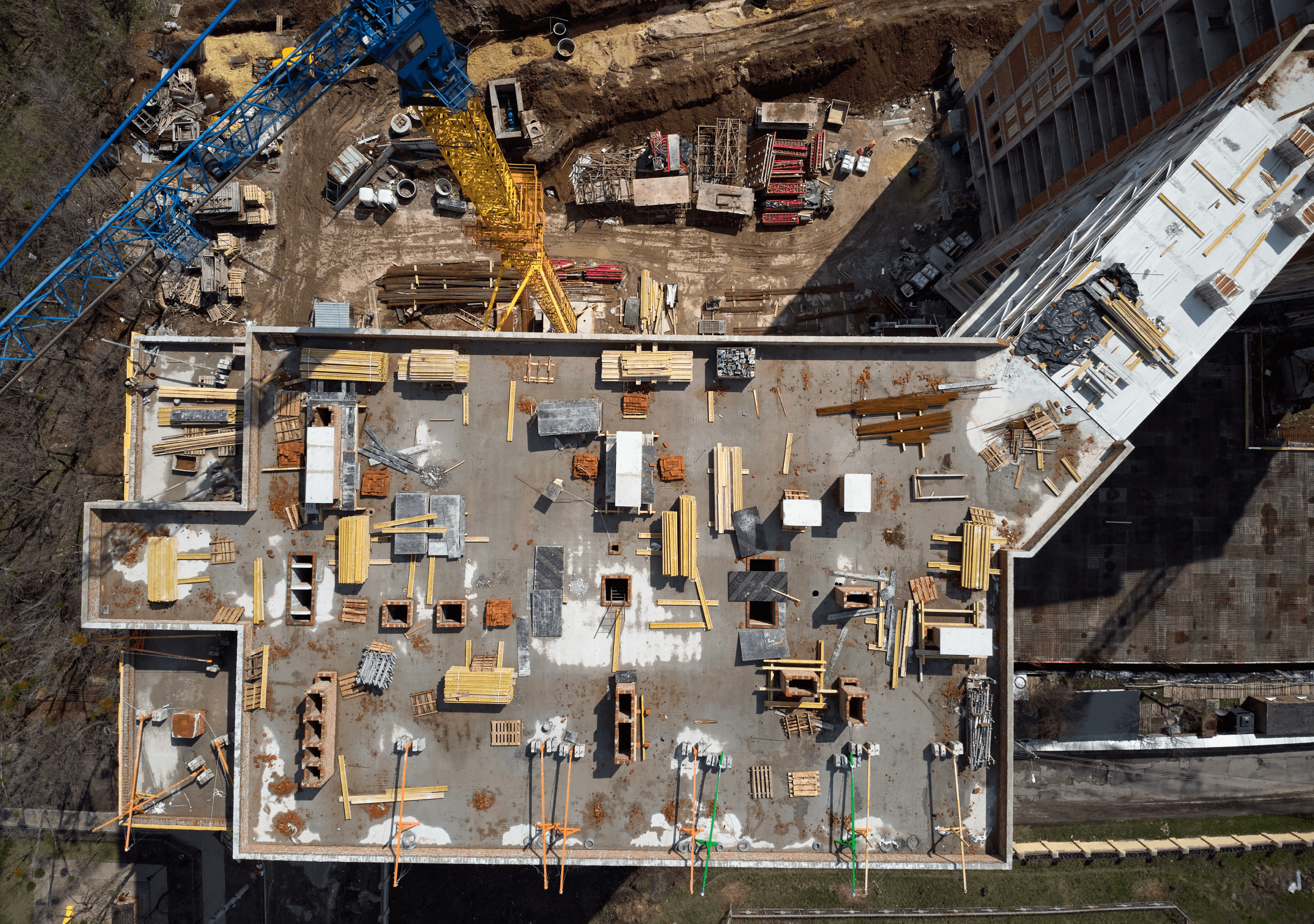
An active overhead construction site. Visible safety conditions like these are the kinds of observations an architect typically logs.
However, not all contracts use AIA language. Some public, institutional, or negotiated projects may introduce modified language or dual observation responsibilities. Some owners ask architects to fill out safety forms as part of a broader documentation process. Every contract is different. If you're unsure whether a request is in scope, check your agreement and talk to your project manager.
Why are architects asked to document site safety?
Even when architects are not responsible for enforcing safety, they are often asked to document what they observe. There are several common reasons:
1. Architects are regularly on site.
During construction administration, architects walk the site to verify installations, observe field conditions, and track progress. While there, it is reasonable to log anything that prevents safe access or could affect inspections.
2. Clients want a second set of observations.
Some owners require documentation from both the contractor and the design team. This helps confirm timelines and conditions if issues arise later.
3. Some firms include safety in QA protocols.
Many architecture firms include a safety section in their field observation templates. This is often for internal use and may be required by firm-wide risk policies. Insurers may also make it a requirement. In some projects, insurers or owner reps want parallel records from all teams to support broader liability coverage or field coordination.
These observations are usually meant to capture visible issues that interfere with inspections, site access, or daily work rather than replace the contractor’s safety logs.
What is typically expected of architects conducting a safety inspection?
When architects are asked to complete safety observations, the scope is usually limited to visible conditions. This includes anything that affects access to the work or presents a clear risk to the design team or visitors.
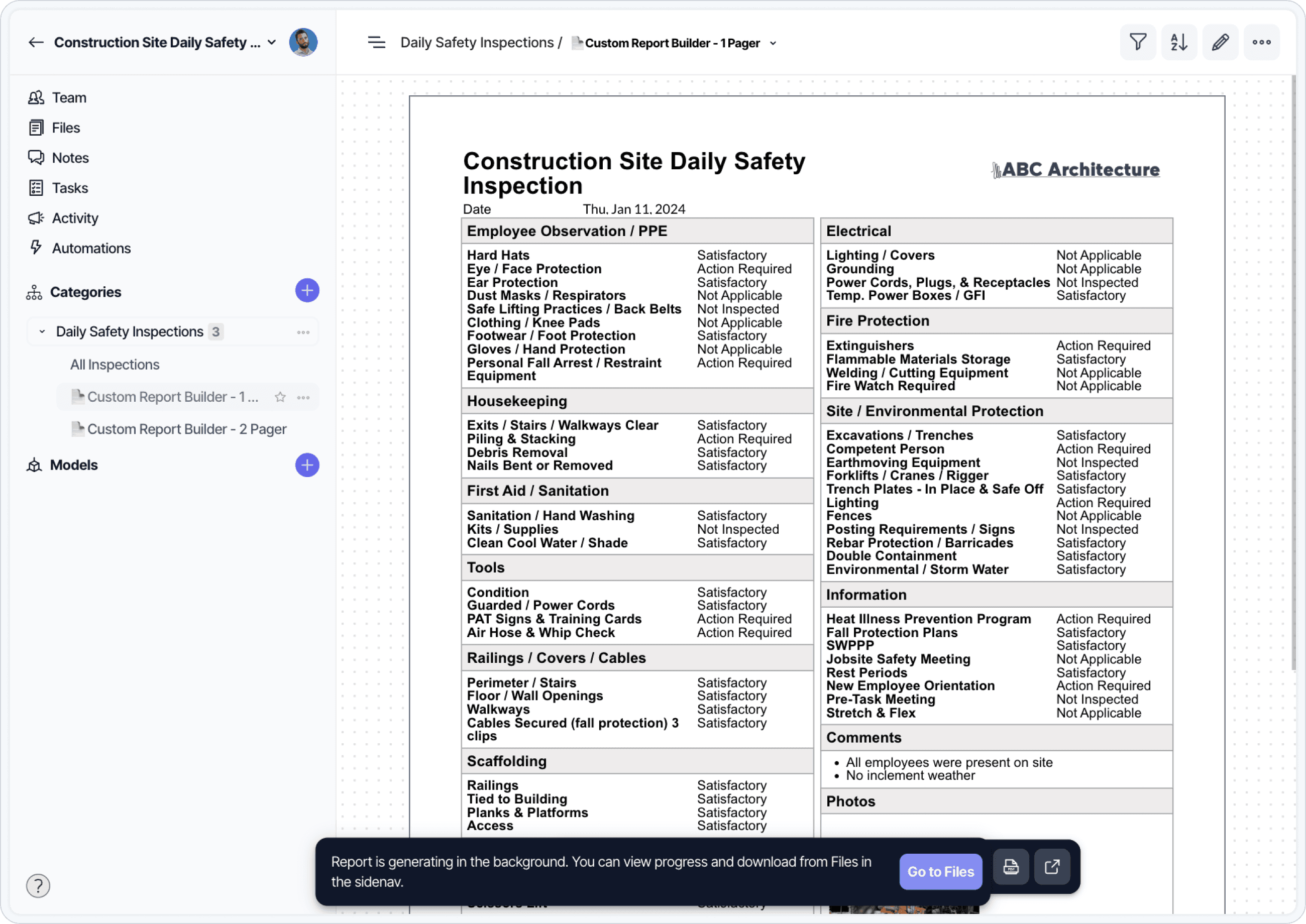
A Daily Safety Inspection report template structured for neutral, factual field observations.
Examples of appropriate observations include:
Missing guardrails or edge protection
Unsecured ladders or scaffolding in work areas
Blocked access paths or stairwells
Standing water, debris, or trip hazards
Workers without visible PPE
Open trenches or floor openings with no signage
Active overhead work with no posted warnings
Unmarked site access during active operations
Your scope will usually be limited to recording what you saw rather than to determining fault or issuing corrective actions. Keep your language neutral and focused on visibility and access.
What should not be included
Architects should not document issues outside their scope or training. Avoid expanding your notes to include formal safety evaluations or conclusions.
Typically your report should not:
Refer to OSHA codes or cite regulatory violations
Assign blame to specific trades or subcontractors
Include assumptions about who caused the issue
Use directive language like "must fix" or "requires correction"
Include safety procedures unrelated to architectural work
Speculate about injury potential or legal risk
Instead, limit your observations to facts. Use location-based notes, photos, and consistent phrasing.
~~Bad Example: I think John from Joe’s Contracting Service left the scaffolding unsecured in the south corridor near Room 114. This is a serious issue because it’s a violation of Code 1234-abc and the local OSHA rep would have a field day telling these guys they’re going to fall and cause a lawsuit. ~~
Good Example: Observed unsecured scaffolding in the south corridor near Room 114 at 10:11 AM. No safety tags visible. Access to Room 114 deferred.
This creates a clear, factual record that explains site limitations without assuming liability.
How to handle requests that fall outside your role
You may be handed a checklist with items that do not apply to your work. These could include questions about contractor procedures, jobsite orientation, or safety certifications. If you are unsure what to do you should always ask your firm’s project manager or lead on how to proceed. Safety issues can have serious injury and legal consequences. If in doubt, it’s always a good idea to ask.
What is the difference between a field report and a safety inspection?
Some architects record safety notes within general field reports. Others use a separate Daily Safety Inspection form. Either approach is acceptable, depending on project requirements.
Field reports typically cover:
Progress observations
Field conditions
Photographs
Weather and site activity
Team coordination notes
Basic safety observations
A separate safety inspection form may be used when the owner requires regular safety-specific documentation or when a firm maintains a separate workflow for recurring site checks.
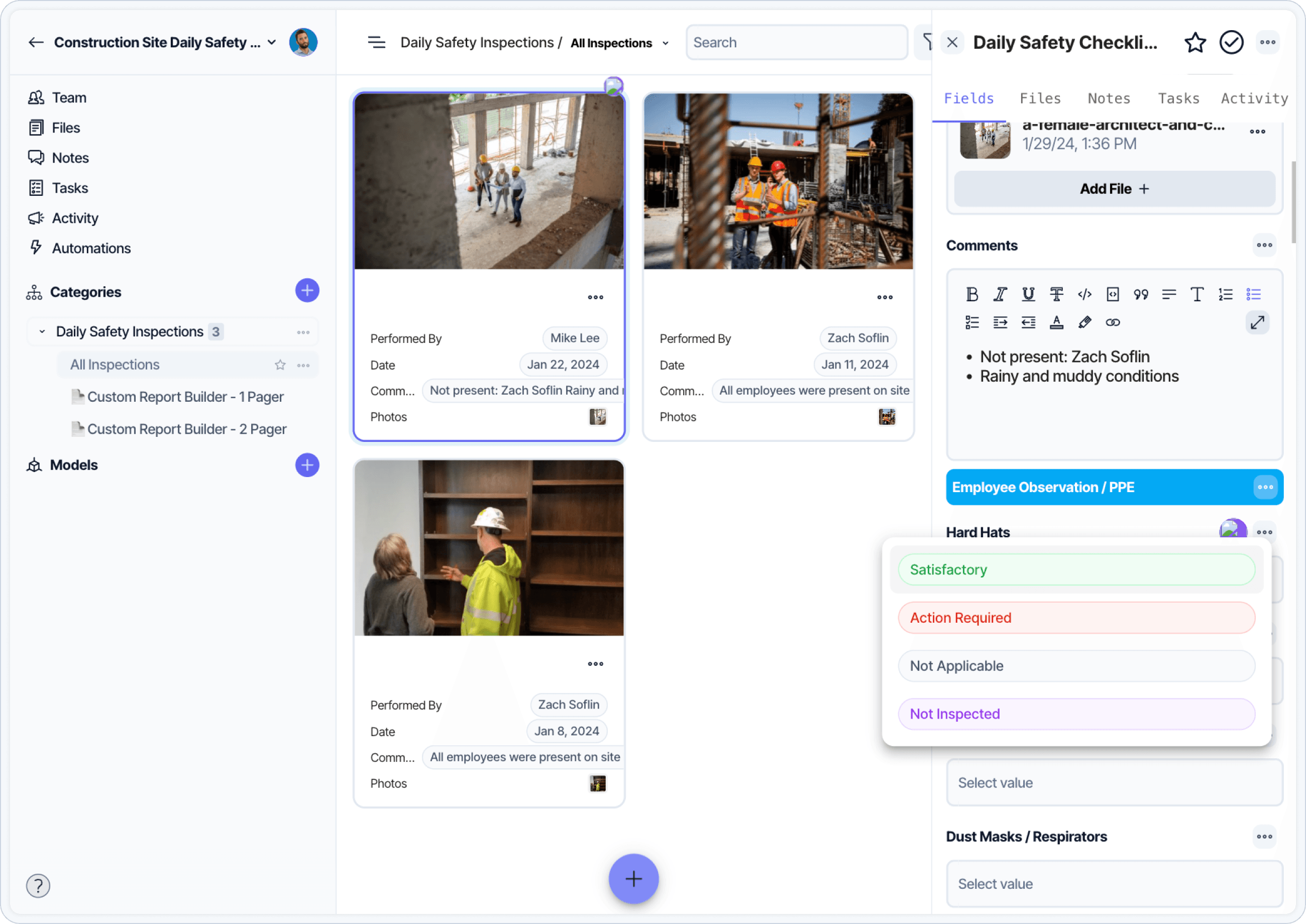
A gallery view of daily safety inspection records compiled across site visits.
Confirm with your project team whether these records are combined or tracked separately. In Layer, observations can be entered once and connected to either a field report or a daily log depending on how your firm has set up the template.
How can you create safety inspection reports in Layer?
Review your contract to understand your safety documentation responsibilities.
Use a standardized form during every scheduled site visit (you can use Layer’s Daily Safety Inspection Template as a starting point). This makes it easier to create consistent looking reports.
Focus on visible hazards that affect access to the work or could be a hazard.
Always provide documentation. Attach photos and use location tags so that everyone is operating from the same information.
Keep language neutral, factual, and scope-specific. Do not use conjecture, speculation, or reference corrective action or liability.
Escalate any urgent concerns to the contractor or PM. If someone is in danger follow your training from site orientation and escalate immediately.
Create any Field Reports, Safety Inspection Reports or other documentation for archive as required in your contract.
An exported Daily Safety Inspection report ready to share or archive per contract.
Further resources
Daily safety observations are not the same as jobsite safety enforcement. When architects are asked to complete safety forms, it is typically to support access planning, field coordination, or project risk documentation. Here are some further resources that may be helpful:
A ready to use workflow for tracking site observations, field conditions, submittals, and installation progress during CA.
A structured process for managing RFI intake, responses, documentation, and coordination across the project team.