Assessments
Learn what ASTM E2018-15 covers, who uses it, and how this standard supports consistent property condition assessments in the architecture and real estate spaces.

What is ASTM E2018-15?
ASTM E2018-15 defines the baseline scope for conducting a Property Condition Assessment (PCA) of an existing commercial building. It is published by ASTM International and establishes a consistent procedure for observing building systems, documenting physical deficiencies, and forecasting immediate and short-term repair costs.
This standard is typically used for due diligence, capital planning, and renovation planning. It limits assessments to visual observations and accessible data. It does not include destructive testing, laboratory analysis, or full code compliance review unless added as supplemental services.

An assessor walking a site with a tablet, capturing observations against the ASTM E2018-15 framework.
Who Uses ASTM E2018-15?
This standard is commonly used in commercial real estate, architecture, engineering, and facility management. Common use cases include:
Pre-purchase due diligence for commercial real estate
Capital planning for institutional or multi-site portfolios
Documentation of existing conditions prior to renovation
Risk analysis for lenders and insurance providers
Users include architects, facility managers, building consultants, property managers, and real estate investors.
Included Building Systems in the Assessment
The standard organizes the PCA into a series of building systems. Each system is reviewed through a walk-through survey to identify observable conditions, deterioration, or deficiencies.
Building System | Included Scope |
|---|---|
Site Improvements | Paving, curbs, walkways, landscaping, signage, site drainage |
Structural Frame | Foundations, load-bearing elements, framing, visual signs of movement |
Building Envelope | Exterior walls, roofs, finishes, water intrusion, flashing |
Mechanical Systems | HVAC units, boilers, controls, heating and cooling distribution |
Electrical Systems | Panels, wiring, emergency power, lighting |
Plumbing Systems | Domestic water supply, waste lines, visible leaks |
Fire Protection Systems | Sprinklers, alarms, extinguishers, emergency lighting |
Accessibility (ADA) | Observed barriers to access in parking, entrances, and interior circulation |
Interior Elements | Floors, ceilings, walls, built-in fixtures, restrooms |
Conveying Systems | Elevators, lifts, general operational condition |
Capital Cost Forecast Categories
ASTM E2018-15 requires cost estimates for observed deficiencies in two categories.
Cost Type | Description |
|---|---|
Immediate Repairs | Corrective action needed within one year due to safety or performance issues |
Short-Term Costs | Expected within two to three years, based on age, wear, or nearing failure |
Estimates are provided in present-day dollars and usually organized by system type.
Items Not Included in the Standard
Unless specifically added to the scope of work, the following services are not included in an ASTM E2018-15 PCA:
Excluded Scope | Notes |
|---|---|
Invasive or destructive testing | No cutting, disassembly, or sampling |
Environmental assessments | Not a substitute for Phase I ESA or hazardous materials survey |
Seismic analysis | Structural seismic risk not evaluated unless scoped separately |
Energy performance reviews | No benchmarking or modeling included |
Code compliance certification | Observations only; no confirmation of full compliance |
Format of the Report
The standard does not dictate the exact report format but does require the inclusion of:
An executive summary
System-by-system observations
Photographic documentation
Tables of recommended repairs and costs
Assumptions and limiting conditions
Reports are generally structured for both technical review and financial planning purposes.
When should you use ASTM E2018-15 for a property assessment?
A Property Condition Assessment conducted under ASTM E2018-15 is used when a building’s physical condition must be documented to support financial decisions, renovation planning, or asset risk evaluation.

An architect documenting site conditions during a Property Condition Assessment.
The standard works like a standardized intake form at a hospital. It ensures that every assessment collects the same core information, regardless of who performs it or where it takes place. This consistency makes reports easier to review, compare, and act on, especially across large portfolios or teams with different technical backgrounds.
Appropriate Use Cases | Not Typically Required When |
|---|---|
Acquiring commercial property with third-party financing | Documenting minor renovations or tenant fit-outs |
Conducting portfolio-wide capital planning | Assessing single systems (e.g. only HVAC or roof replacement) |
Establishing existing conditions before major renovations | Performing detailed code compliance or forensic investigations |
Meeting lender, insurer, or board review requirements | Creating marketing materials or general facility walkthroughs |
Generating documentation for institutional or public ownership | Informal in-house facility reviews without external reporting needs |
ASTM E2018-15 is most effective when conditions must be reported in a way that can be audited, compared, or reviewed by parties beyond the field assessor. For informal reviews or isolated scopes, a simplified internal checklist or discipline-specific report may be more appropriate.
How to Document a PCA in Layer
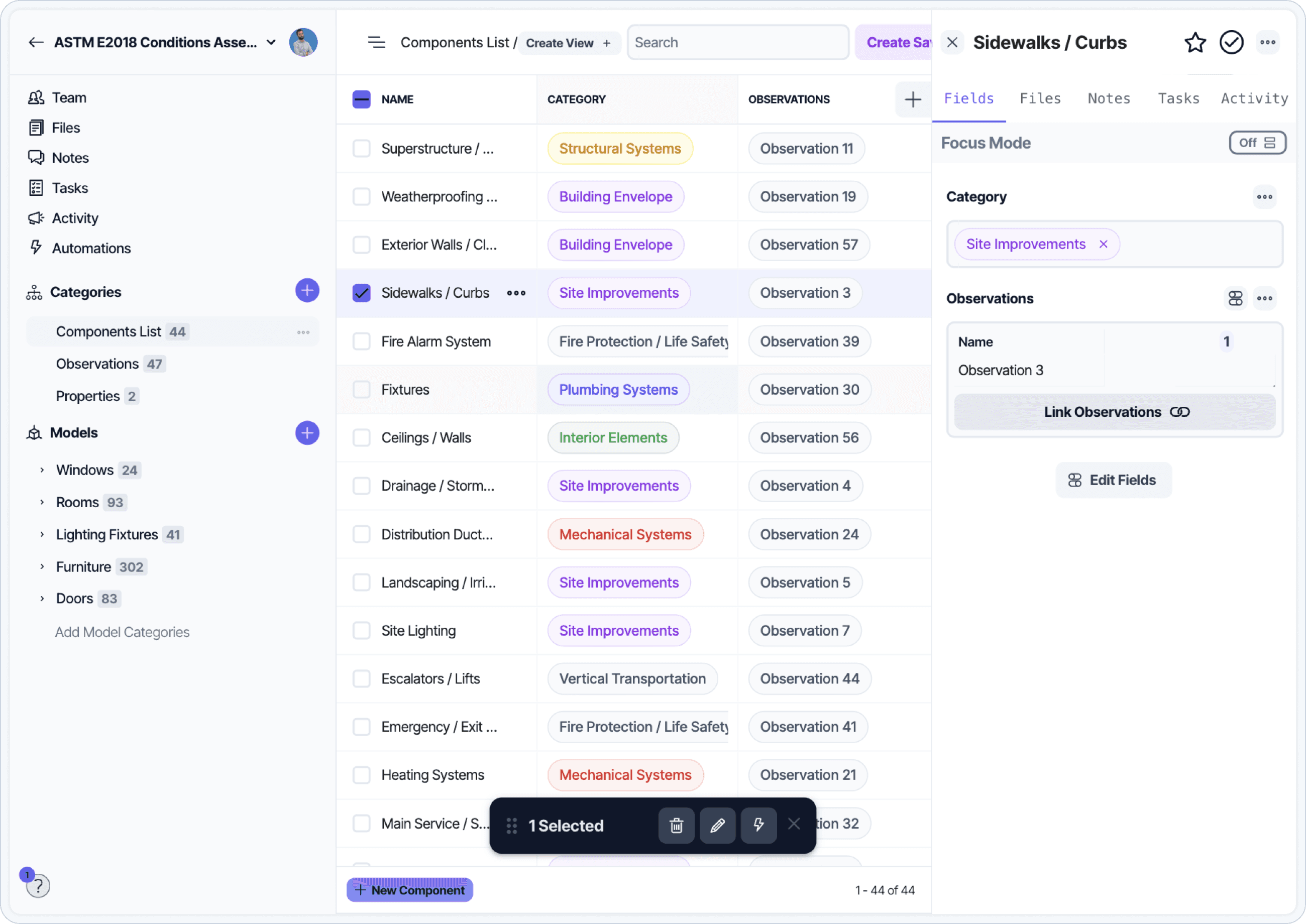
An ASTM E2018 assessment components list captured in Layer, with each system pre-structured to the standard.
Layer includes a configurable template based on ASTM E2018-15. The template contains pre-structured categories that match the standard’s scope. Field users can document:
Condition ratings
Photo evidence
Cost estimates
Trade responsibility
Repair priority
Collected data can be tagged by location, synced to Revit (if needed), and summarized in views or reports.
Frequently Asked Questions
What does ASTM E2018-15 cover?
ASTM E2018-15 defines the baseline scope for conducting a Property Condition Assessment (PCA) of an existing commercial building. It establishes a consistent procedure for observing building systems, documenting physical deficiencies, and forecasting immediate and short-term repair costs.
Who uses ASTM E2018-15?
Architects, facility managers, building consultants, property managers, real estate investors, lenders, and insurance providers use ASTM E2018-15. It is most commonly applied to pre-purchase due diligence, capital planning, renovation planning, and risk analysis.
What is a Property Condition Assessment (PCA)?
A PCA is a structured evaluation of an existing building’s condition. Under ASTM E2018-15, the PCA includes a walk-through survey of building systems, documentation of observable deficiencies, and a forecast of immediate and short-term repair costs.
What does ASTM E2018-15 not include?
Unless added to the scope of work, the standard does not include invasive or destructive testing, environmental assessments (Phase I ESA), seismic analysis, energy performance reviews, or full code compliance certification. The standard limits the assessment to visual observations and accessible data.
What building systems are evaluated?
The standard organizes the PCA into ten system categories: site improvements, structural frame, building envelope, mechanical systems, electrical systems, plumbing systems, fire protection systems, accessibility (ADA), interior elements, and conveying systems (elevators).
What is the difference between immediate repairs and short-term costs in a PCA?
Immediate repairs require corrective action within one year due to safety or performance issues. Short-term costs are expected within two to three years based on age, wear, or nearing failure. Both are forecasted in present-day dollars and organized by system type.
When is ASTM E2018-15 not the right standard?
ASTM E2018-15 is not typically required for minor renovations or tenant fit-outs, single-system assessments (only HVAC or only roof), detailed code compliance investigations, marketing materials, or informal in-house facility reviews. Simpler internal checklists may be more appropriate for these cases.
How does ASTM E2018-15 relate to Phase I Environmental Site Assessments?
They are different. ASTM E1527 covers Phase I Environmental Site Assessments (ESAs), which evaluate environmental contamination risk. ASTM E2018-15 covers physical building condition. Both are commonly performed during commercial real estate due diligence but address different concerns.
Further Resources
The Building Survey Process Explained. The broader survey process where ASTM E2018-15 sits as one specialized standard.
The Layer Guide to Property Inspections. Property inspection workflow that often uses ASTM E2018-15 as the framework.
Assessment, Inspection, or Survey: What's the Real Difference?. Clarifies the distinctions between related survey types.
Everything You Need to Know About Property Inspections in Commercial Lending. Property inspections in commercial real estate context.
An Introduction to Equipment Inventory Surveys. The specialized equipment survey companion.
5 Methods for Documenting Existing Conditions. Practical methods for capturing existing-conditions data on site.
The Architectural Design Process Explained. Where ASTM E2018-15 PCAs feed into Pre-Design.
ASTM E2018 Assessment Workflow Template in Layer. Pre-configured workflow for documenting PCAs in line with the standard.
Property Assessment Workflow Template in Layer. For broader property condition assessments.